

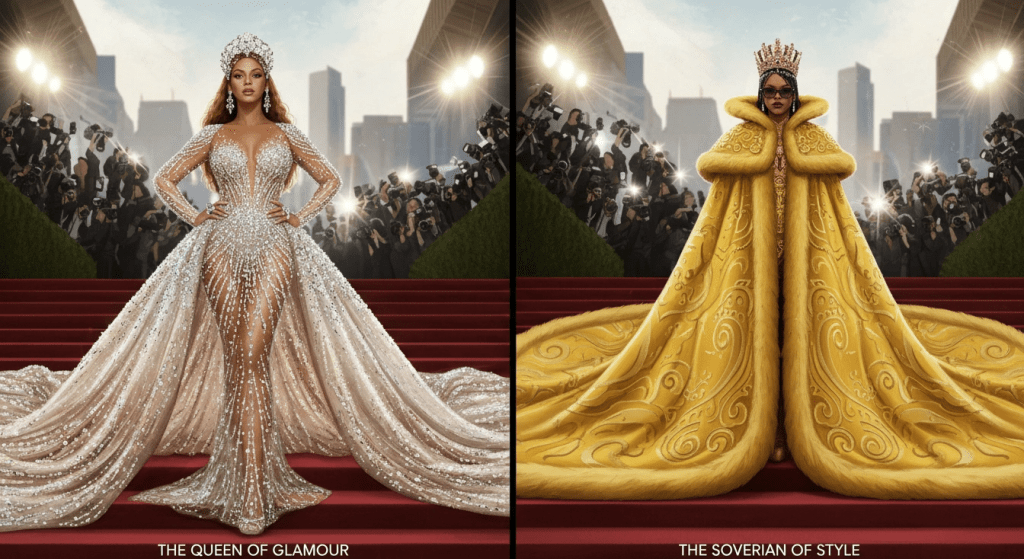
Beyoncé’s Met Gala Chairmanship and the Shadow of Rihanna’s Reign
By Dwayne Hinds
The fashion industry, a realm often characterized by its fleeting trends and ephemeral obsessions, experienced a seismic shift this week. The Metropolitan Museum of Art’s Costume Institute officially announced that Beyoncé Knowles-Carter will serve as a co-chair for the 2026 Met Gala. After a decade-long hiatus; a period during which the “Queen B” transitioned from a pop superstar to a global cultural deity; she is finally returning to the hallowed steps of the Met. The news, predictably, ignited a firestorm of digital discourse, with fans and critics alike hailing the return of a legend.
However, as the initial euphoria begins to settle into a more nuanced analysis, a persistent and provocative question has emerged in me: Can Beyoncé’s return truly restore the Met Gala to its former glory, or has the “Queen of the Met” title already been permanently retired by Rihanna? While Beyoncé’s involvement brings an undeniable level of prestige and “A-list” gravity to the event, there is a growing sentiment that her approach to the Met Gala; and the event itself in her absence; has lost the experimental, avant-garde edge that defines a true “fashion moment.” In contrast, Rihanna’s legacy at the Met is not merely about being well-dressed; it is about fundamentally shifting the cultural conversation through radical risk-taking and an almost religious devotion to the event’s themes.
I am here to explores the “Beyoncé Effect” on the 2026 Met Gala, analyzes the stylistic evolution of both icons, and argues that while Beyoncé may be the most powerful woman in music, Rihanna remains the undisputed sovereign of the Met Gala’s red carpet.
The “Beyoncé Effect” and the 2026 Met Gala
The 2026 Met Gala, themed “Costume Art,” promises to be a landmark event. Co-chaired by Beyoncé alongside Venus Williams, Nicole Kidman, Zoë Kravitz, and Saint Laurent’s Anthony Vaccarello, the gala aims to explore the body as a living canvas and fashion as a multidimensional art form. The choice of Beyoncé as a chair is a masterstroke by Anna Wintour, the legendary editor-in-chief of Vogue and the architect of the modern Met Gala.
For years, critics have lamented the “influencer-ification” of the Met Gala, arguing that the inclusion of TikTok stars and reality TV personalities has diluted the event’s exclusivity and high-fashion pedigree. By securing Beyoncé; a figure who embodies the pinnacle of old-school celebrity and modern cultural influence; Wintour is signaling a return to form. The “Beyoncé Effect” is already being felt; industry insiders predict a surge in high-profile attendance, with names like Adele, Jay-Z, and Zendaya rumored to be on the guest list specifically because of Beyoncé’s involvement.
Yet, the “Beyoncé Effect” is as much about branding as it is about fashion. Beyoncé’s brand is built on perfection, control, and a meticulously curated image. While this makes her a formidable business mogul and a peerless performer, it can sometimes translate to a “safe” or overly polished presence on the red carpet. The Met Gala, at its best, is a place for the unexpected, the grotesque, and the revolutionary. It is a place where fashion is not just beautiful, but challenging.
To understand why some feel Beyoncé’s showing is “not as hot” as Rihanna’s, one must look back at her history with the event. Beyoncé’s Met Gala journey began in 2008, and for nearly a decade, she was a fixture on the steps.
In 2008, for the theme “Superheroes: Fashion and Fantasy,” Beyoncé wore a blush-pink Armani Privé gown. It was elegant, flattering, and safe. In 2011, for “Alexander McQueen: Savage Beauty,” she wore a black and gold Emilio Pucci gown that was so tight she famously had to be carried up the stairs. While these looks were stunning, they were essentially “red carpet” dresses; beautiful garments that could have been worn to the Oscars or the Grammys. They didn’t necessarily engage with the theme in a profound or transformative way.
From 2012 to 2016, Beyoncé entered what many consider her most iconic Met Gala phase, characterized by a series of custom Givenchy Haute Couture creations by Riccardo Tisci.
•2012 (Schiaparelli and Prada: Impossible Conversations): A black sheer gown with a purple feather train.
•2013 (Punk: Chaos to Couture): A flame-printed gown with matching boots and gloves.
•2014 (Charles James: Beyond Fashion): A beaded black gown with a veil.
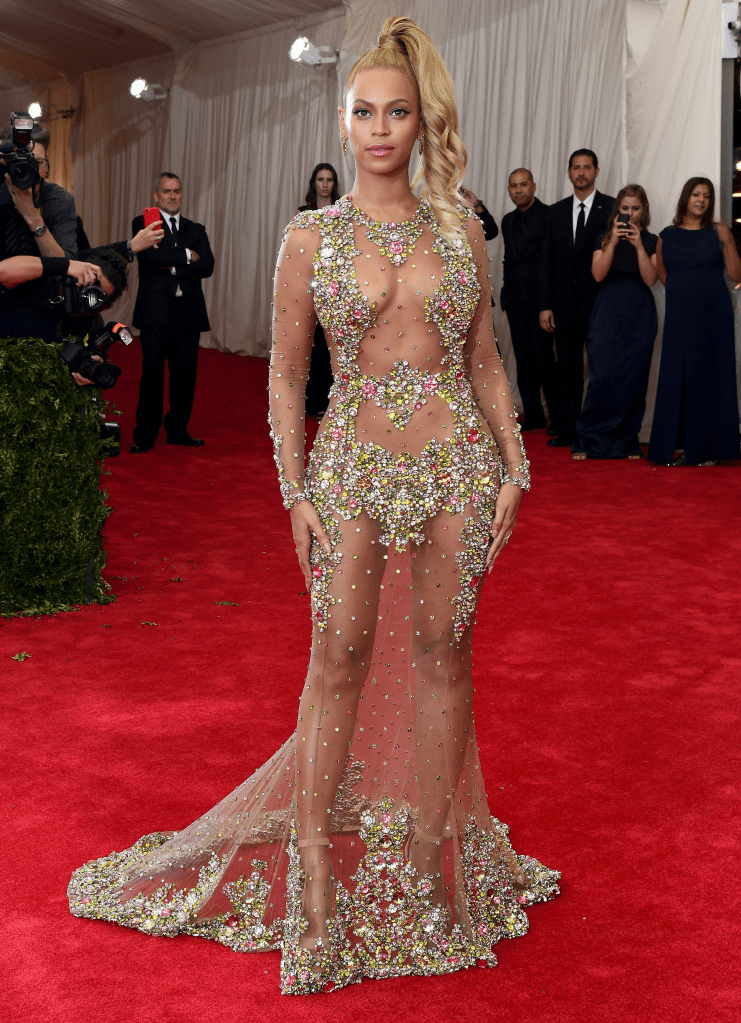
•2015 (China: Through the Looking Glass): The “Naked Dress”; a sheer gown adorned with strategically placed crystals.
•2016 (Manus x Machina: Fashion in an Age of Technology): A peach-colored latex gown.
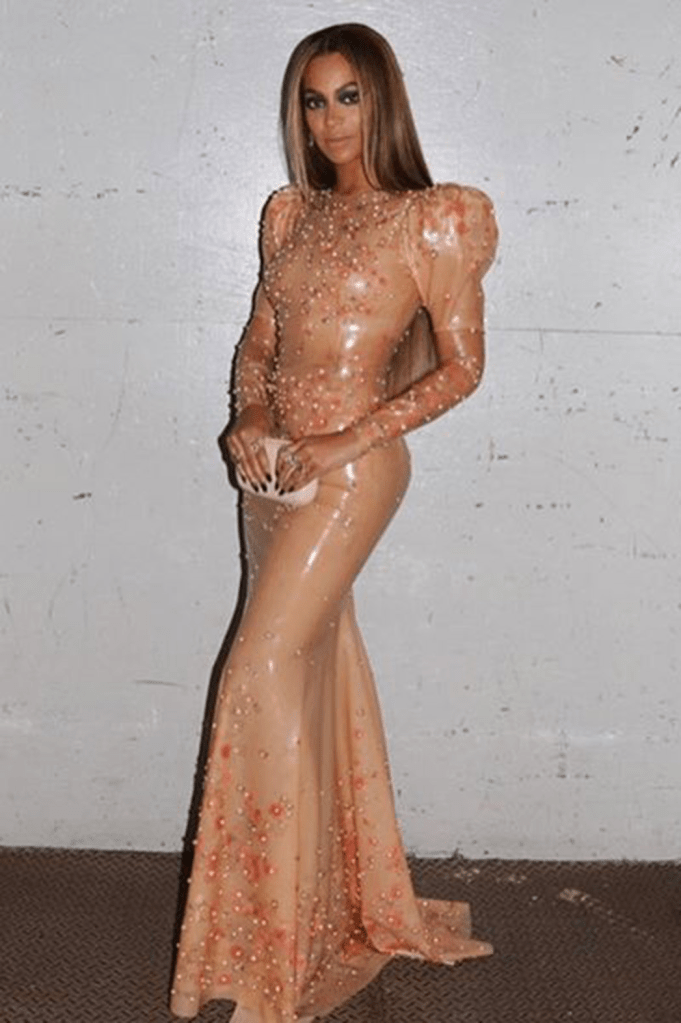
The 2015 “Naked Dress” remains Beyoncé’s most famous Met Gala look. It was a moment of pure, unadulterated stardom. However, even this look was criticized by some fashion purists for ignoring the “China” theme in favor of a trend (the sheer dress) that was already becoming ubiquitous. Similarly, the 2016 latex gown, while technically impressive, felt more like a costume for a music video than a high-fashion interpretation of the “Manus x Machina” theme.
Beyoncé’s Met Gala history is a testament to her beauty and her status as a muse for major designers. But it is also a history of staying within the lines of “glamour.” She rarely, if ever, allows the fashion to overshadow her own persona. She is always Beyoncé, first and foremost.
The Rihanna Revolution: Why She Owns the Steps
If Beyoncé is the Queen of Glamour, Rihanna is the Queen of the Avant-Garde. Rihanna’s relationship with the Met Gala is fundamentally different. She doesn’t just attend the event; she interprets it. She treats the theme not as a suggestion, but as a challenge to be conquered.
The 2015 Met Gala, “China: Through the Looking Glass,” I believe was the night Rihanna officially claimed the crown. While other celebrities (including Beyoncé) opted for sheer, Western-style gowns, Rihanna chose a massive, canary-yellow fur-trimmed cape by Chinese couturier Guo Pei. The garment took one woman two years to hand-make and weighed 55 pounds.
This look was a cultural reset. It was viral, it was memed (the “omelet” dress), and it was undeniably high fashion. Most importantly, it was a profound act of cultural appreciation. By choosing a Chinese designer for a China-themed event, Rihanna showed a level of intellectual and aesthetic depth that is rare in celebrity fashion. She didn’t just look good; she made a statement about the global nature of couture.
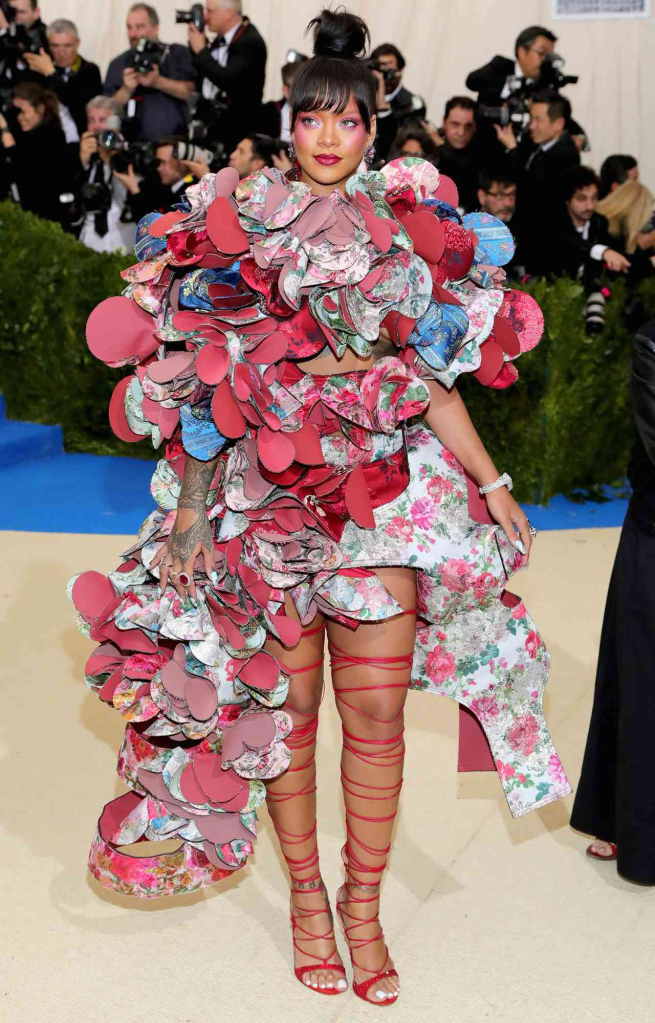
In 2017, for the theme “Rei Kawakubo/Comme des Garçons: Art of the In-Between,” Rihanna was one of the few attendees who actually wore Comme des Garçons. She appeared in a sculptural, multi-layered floral creation that obscured her silhouette and challenged traditional notions of beauty. It was a difficult, challenging look that most celebrities would have been too afraid to wear. Rihanna wore it with a confidence that suggested she was the only person in the room who truly understood the assignment.
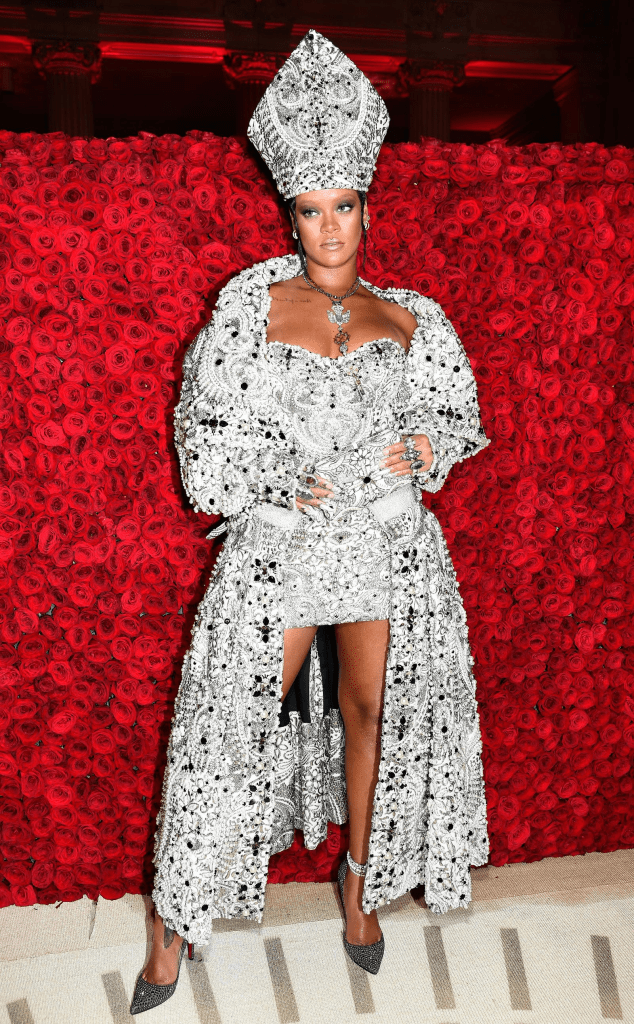
For “Heavenly Bodies: Fashion and the Catholic Imagination,” Rihanna served as a co-chair. She arrived in a custom Maison Margiela ensemble by John Galliano, featuring a beaded mini-dress, a matching coat, and a full papal miter (the Pope’s hat). It was a daring, potentially controversial look that perfectly captured the intersection of religion and high fashion. It was theatrical, irreverent, and utterly unforgettable.
This my breakdown of the Beyoncé’s and Rihanna’s showing
| Feature | Beyoncé’s Met Gala Approach | Rihanna’s Met Gala Approach |
| Style Philosophy | High-glamour, silhouette-focused, often Givenchy-centric. | Experimental, architectural, and theme-obsessed. |
| Cultural Impact | Celebrated for beauty and status; “The Queen has arrived.” | Viral sensations that redefine the theme; “The Met Gala has begun.” |
| Risk Level | Moderate; focuses on flattering the form and maintaining brand image. | High; willing to wear heavy, unconventional, or controversial pieces. |
| Memorable Look | 2015 “Naked Dress” (Givenchy Haute Couture). | 2015 “Omelet Dress” (Guo Pei) & 2018 “Papal Chic” (Maison Margiela). |
When I say Beyoncé’s showing is “not as hot” as Rihanna’s, we are talking about the temperature of the cultural conversation. Beyoncé’s appearances are like a perfectly executed symphony; beautiful, harmonious, and technically flawless. Rihanna’s appearances are like a riot; unpredictable, loud, and impossible to ignore.
Rihanna understands that the Met Gala is not a beauty pageant; it is a costume ball. She is willing to look “ugly” or “weird” in the pursuit of a fashion concept. She is willing to let the clothes wear her, rather than the other way around. This selflessness in the face of art is what makes her the “hottest” figure at the Met.
Furthermore, there is the element of the “Late Arrival.” Rihanna has turned her late arrivals into a performance in themselves. The entire world waits for her. The red carpet literally stops when she steps out of her car. This level of anticipation is something that even Beyoncé, with all her power, has not quite replicated at the Met. Beyoncé’s return in 2026 will be a massive moment, but it will be a moment of reclamation. Rihanna’s moments are always moments of revelation.
The Met Gala has always been a delicate balancing act between high art and high commerce. Since Anna Wintour took over as chair in 1995, the event has transformed from a local charity benefit for the Metropolitan Museum of Art’s Costume Institute into a global media phenomenon. It is often called “the Oscars of the East Coast,” but that title doesn’t quite capture its unique cultural position. The Met Gala is a place where the worlds of fashion, film, music, and technology collide in a spectacular display of wealth and creativity.
However, in recent years, the “spectacular” part of the equation has begun to feel a bit hollow. The rise of social media and the “influencer economy” has had a profound impact on the event’s guest list and its overall vibe. In 2021 and 2022, the inclusion of TikTok stars like Addison Rae and Charli D’Amelio sparked a backlash from fashion purists who felt the event was losing its exclusivity. The red carpet, once a place for avant-garde experimentation, began to look more like a high-end prom.
This is where the “Beyoncé Effect” comes in. By securing Beyoncé as a co-chair for 2026, Anna Wintour is attempting to re-establish the Met Gala’s “A-list” credentials. Beyoncé is one of the few remaining celebrities who possesses a level of “mystique” that is increasingly rare in the age of oversharing. She doesn’t do interviews, she doesn’t post “get ready with me” videos, and she doesn’t engage in public feuds. She is a figure of immense power and poise, and her presence alone is enough to elevate any event.
But there is a downside to this reliance on “star power.” When the Met Gala becomes too focused on the celebrities themselves, the fashion often takes a backseat. Beyoncé’s brand is so powerful that it can sometimes overshadow the theme of the exhibition. In 2015, for “China: Through the Looking Glass,” Beyoncé’s “Naked Dress” was the most talked-about look of the night, but it had almost nothing to do with the theme. It was a “Beyoncé moment,” not a “Met Gala moment.”
In contrast, Rihanna’s most iconic looks are always “Met Gala moments.” When she wore the yellow Guo Pei gown, she wasn’t just showing off her body or her status; she was honoring the theme and the designer. She was using her platform to highlight a specific cultural and aesthetic tradition. This is the difference between a celebrity who uses the Met Gala as a backdrop for their own brand and a celebrity who uses their brand to elevate the Met Gala.
The “Costume Art” Theme; Is it a Perfect Stage for Beyoncé?
The theme for the 2026 Met Gala, “Costume Art,” is particularly intriguing. According to the Costume Institute, the exhibition will explore the body as a living canvas and fashion as a multidimensional art form. It will feature more than 200 works portraying the dressed body throughout Western art history, from the Renaissance to the present day.
This theme seems tailor-made for Beyoncé. Throughout her career, she has used fashion as a tool for storytelling and self-expression. From the African-inspired aesthetics of Black Is King to the futuristic, high-tech looks of the Renaissance tour, Beyoncé has consistently pushed the boundaries of what “costume” can be. She understands the power of the visual, and she knows how to use her body as a canvas for art.
As a co-chair, Beyoncé will have a significant influence on the direction of the gala. She will likely work closely with Andrew Bolton, the curator in charge of the Costume Institute, to ensure that the event is a true celebration of “Costume Art.” This could mean a return to more theatrical, avant-garde dressing on the red carpet. It could also mean a more diverse and inclusive guest list, reflecting Beyoncé’s own commitment to highlighting Black excellence and global culture.
But even with this perfect theme, the comparison to Rihanna is unavoidable. Rihanna has already proven that she can handle “artistic” themes with ease. Her 2017 Comme des Garçons look was a literal piece of wearable art. Her 2018 “Papal Chic” look was a masterclass in thematic interpretation. If Rihanna attends the 2026 gala, she will undoubtedly bring a level of creativity and risk-taking that will be hard for anyone; even Beyoncé; to match.
To truly understand the difference between Beyoncé and Rihanna’s Met Gala approaches, one must also look at the people behind the scenes: their stylists. For much of her Met Gala history, Beyoncé worked closely with Ty Hunter, a man who has been by her side since the early days of Destiny’s Child. Hunter’s approach to Beyoncé’s style is rooted in “glamour” and “perfection.” He knows exactly what looks good on her, and he focuses on creating looks that are flattering, elegant, and on-brand.
In an interview with Vibe, Hunter explained the story behind some of Beyoncé’s most famous Met Gala looks. For the 2015 “Naked Dress,” he revealed that they actually chose the gown just hours before the event. It was a spontaneous decision based on what felt “right” in the moment. This spontaneity is part of what makes Beyoncé’s looks so successful, but it also suggests a lack of deep thematic engagement. The focus is on the “moment,” not the “message.”
Rihanna, on the other hand, has worked with a variety of stylists over the years, most notably Mel Ottenberg and Jahleel Weaver. Ottenberg, in particular, was instrumental in creating Rihanna’s most iconic Met Gala looks. His approach is much more experimental and research-driven. For the 2015 Guo Pei gown, Ottenberg and Rihanna spent months researching Chinese designers and looking for a piece that would truly honor the theme. They weren’t just looking for a “pretty dress”; they were looking for a “fashion statement.”
This difference in styling philosophy is reflected in the final results. Beyoncé’s looks are often “beautiful,” but Rihanna’s looks are “significant.” Beyoncé’s looks are about the “now,” while Rihanna’s looks are about the “forever.”
In the digital age, the success of a Met Gala look is often measured by its “virality.” How many memes did it inspire? How many times was it shared on Instagram? How many headlines did it generate? By these metrics, both Beyoncé and Rihanna are incredibly successful. But the nature of their virality is different.
Beyoncé’s virality is often driven by her sheer star power. When she arrives at the Met, the internet explodes because “The Queen is here.” People share photos of her because she looks stunning, because she is powerful, and because she is Beyoncé. Her impact is broad and immediate.
Rihanna’s virality, however, is often driven by the fashion itself. The “omelet dress” meme was not just about Rihanna; it was about the sheer audacity and scale of the garment. It was a conversation about fashion as a form of public art. Rihanna’s looks often spark deeper discussions about cultural appropriation vs. appreciation, the role of religion in fashion, and the boundaries of gender and beauty.
Furthermore, Rihanna’s impact extends beyond the digital realm and into the museum itself. Her Guo Pei gown is now a part of fashion history, often cited in textbooks and exhibitions as a prime example of how a celebrity can use their platform to highlight global couture. It is a look that has “staying power” in a way that few other Met Gala looks do.
Ultimately, the debate over who “owns” the Met Gala comes down to a difference in roles. Beyoncé is, first and foremost, a musician and a performer. The Met Gala is just one of many stages she uses to project her image and her brand. She is the “Queen of Music,” and her presence at the Met is a testament to her status as a global icon.
Rihanna, however, has increasingly become a “fashion person” who also happens to make music (though her fans are still waiting for that next album). Between her Fenty Beauty empire and her Savage X Fenty lingerie line, Rihanna has fundamentally reshaped the fashion and beauty industries. Her relationship with fashion is not just about wearing clothes; it is about creating them, analyzing them, and pushing them forward.
This is why Rihanna remains the “Sovereign of Style” at the Met. She is a true insider who understands the nuances of the industry. She is not just a guest at the party; she is one of the people who defines what the party is. Beyoncé’s return as a chair is a massive “get” for the Met Gala, but it feels like a celebrity endorsement. Rihanna’s presence feels like a creative necessity.
As I look toward May 2026, the world will undoubtedly be watching Beyoncé. Her first appearance in ten years, and her first as a chair, will be a masterclass in celebrity branding and high-fashion glamour. She will look stunning, she will be the center of attention, and she will undoubtedly “win” the night in terms of headlines and social media engagement.
But for those who crave the shock of the new, the thrill of the avant-garde, and the profound cultural resonance of a true “fashion moment,” the shadow of Rihanna will loom large. Beyoncé may be the Queen of Music, but when it comes to the steps of the Met, Rihanna remains the undisputed champion. Beyoncé’s showing will be beautiful, but Rihanna’s showings are legendary.
The 2026 Met Gala will be a fascinating test of these two different approaches to fashion and celebrity. Will Beyoncé use her position as chair to push the boundaries of “Costume Art” and surprise us with something truly revolutionary? Or will she stick to the “safe” glamour that has defined her Met Gala history? And if Rihanna attends, will she once again “steal the show” with a look that redefines the theme and captures the global imagination?
Only time will tell. But one thing is certain: the steps of the Met have never seen a rivalry quite like this. Whether you are Team Beyoncé or Team Rihanna, there is no denying that these two women have fundamentally changed the way we think about fashion, celebrity, and the power of the visual. And in the end, that is the true legacy of the Met Gala.
The Future of the Met Gala: A New Era of “Costume Art”
As we look toward the 2026 Met Gala, it is clear that the event is at a crossroads. The “Costume Art” theme is a bold statement about the future of fashion and its place in the world of art. It is a theme that challenges us to think about the body as a living canvas and fashion as a multidimensional art form.
Beyoncé’s role as a co-chair is a significant step in this new direction. She is a figure who embodies the intersection of fashion, music, and art, and her influence will undoubtedly be felt throughout the gala. She will likely use her platform to highlight the work of Black designers and artists, and she will undoubtedly bring a level of prestige and “A-list” gravity to the event.
But the comparison to Rihanna is more than just a fashion debate. It is a conversation about the nature of celebrity and the role of the “icon” in the 21st century. Beyoncé is a figure of immense power and poise, but she is also a figure of meticulous control. Rihanna, on the other hand, is a figure of radical experimentation and risk-taking.
In the end, the Met Gala needs both of these queens. It needs the “Beyoncé Effect” to maintain its status as a global media phenomenon and to attract the biggest names in the industry. But it also needs the “Rihanna Revolution” to push the boundaries of fashion and to keep the event from becoming too “safe” or “predictable.”
I believe the 2026 Met Gala will be a fascinating test of these two different approaches to fashion and celebrity. Will Beyoncé use her position as chair to surprise us with something truly revolutionary? Or will she stick to the “safe” glamour that has defined her Met Gala history? And if Rihanna attends, will she once again “steal the show” with a look that redefines the theme and captures the global imagination?
Only time will tell. But one thing is certain: the steps of the Met have never seen a rivalry quite like this. Whether you are Team Beyoncé or Team Rihanna, there is no denying that these two women have fundamentally changed the way we think about fashion, celebrity, and the power of the visual. And in the end, that is the true legacy of the Met Gala.
As I countdown to May 2026 begins, the fashion world is buzzing with anticipation. The “Costume Art” exhibition will be a landmark event, and the gala itself will be a night to remember. But for those who crave the shock of the new and the thrill of the avant-garde, the shadow of Rihanna will loom large. Beyoncé may be the Queen of Music, but when it comes to the steps of the Met, Rihanna remains the undisputed sovereign of style. Beyoncé’s showing will be beautiful, but Rihanna’s showings are legendary.
The Met Gala is more than just a party; it is a cultural barometer. It tells us where we are as a society and where we are going. And in the age of Beyoncé and Rihanna, it tells us that fashion is more than just clothes; it is a form of power, a form of art, and a form of revolution. Whether you are a fan of Beyoncé’s “safe” glamour or Rihanna’s “radical” experimentation, there is no denying that these two women are the architects of our modern fashion landscape. And as they prepare to take the steps of the Met once again, the world will be watching, waiting, and wondering: who will be the next Queen of the Met?


Leave a Reply