


Dwayne Hinds
I believe and saw that Jamaica is a land of paradoxes, but perhaps none is as striking as the one found on the blue tracks of the National Stadium in Kingston. Every year, during the Inter-Secondary Schools Boys and Girls Championships; affectionately known as “Champs”; the island produces a surplus of talent that would be the envy of any other nation on earth. We are not just producing athletes; we are producing legends in the making, year after year, with a consistency that defies logic for a nation of less than three million people. Yet, this very excellence has created a crisis that threatens the future of Jamaican track and field.
As I watched the recent discussion led by Richard Blackford and Missa B regarding the plight of our sub-10-second sprinters, the reality of our situation became painfully clear. We have an incredible surplus of elite talent, yet the current regulations from World Athletics (WAF) are, in my opinion, doing more harm than good for the next generation of Jamaican track stars. While national pride is often the focus of our sporting discourse, we must confront the uncomfortable truth: when a country has more world-class talent than available spots, restrictive qualification and transfer policies do not just protect the sport; they stifle careers and trap elite athletes in a cycle of missed opportunities.
I believe that Jamaica needs to lobby for the World Athletics Federation (WAF) to increase the amount of persons that can qualify based on speed, instead of placement. Whether we like it or not, Jamaica will end up losing good Jamaican athletes to other countries. This is not because of a lack of patriotism, but because we are producing legends every year at the Girls and Boys Champs who simply have nowhere to go within our own national structure.

Usain Bolt, the ultimate product of the Jamaican sprint factory, whose legacy continues to inspire the next generation.
To understand why the current system is failing Jamaica, one must first understand the sheer scale of talent emerging from our high school system. Champs is not just a track meet; it is a cultural phenomenon and a high-performance incubator. It is where the likes of Usain Bolt, Shelly-Ann Fraser-Pryce, and Elaine Thompson-Herah first showed the world what they were capable of. But for every Bolt or Fraser-Pryce who makes it to the global stage, there are dozens of others who are running times that would make them national heroes in almost any other country, yet they struggle to even make a final at our National Senior Championships.
The level of competition in Jamaica is so high that the “top three” rule for major international championships; the Olympics and the World Championships; has become a bottleneck. Consider the current crop of male sprinters: Kishane Thompson, Oblique Seville, and Ackeem Blake. These are men who are consistently running sub-10-second times. In any given year, we might have six or seven men who have met the World Athletics entry standard. Yet, because of the current rules, only three can represent the black, green, and gold in the individual 100m event.
This creates a scenario where an athlete like Yohan Blake, the second-fastest man in history, can find himself struggling to secure a spot on the national team in the twilight of his career, not because he isn’t world-class, but because the younger generation is so densely packed with talent. When a legend like Blake, or a rising star who has clocked a 9.90, is forced to watch the World Championships from their couch because they finished fourth at the Jamaican trials, we have a problem. This is not just a sporting tragedy; it is an economic one.

Legends like Shelly-Ann Fraser-Pryce and Elaine Thompson-Herah have dominated the global stage, but the depth of Jamaican talent means many others are left behind.
The current World Athletics qualification system is a hybrid of entry standards (speed) and world rankings (placement/consistency). While this system aims to ensure a diverse global field, it fails to account for the unique concentration of talent in sprint-heavy nations like Jamaica.
I am advocating for a shift in this philosophy. If an athlete has proven they are among the fastest in the world by hitting a certain elite time; say, sub-10.00 for men or sub-11.00 for women; they should be allowed to compete on the world stage, regardless of whether they were the fourth or fifth person to do so in their country.
Why should the world be deprived of seeing the fifth-fastest man on the planet compete just because he happens to be Jamaican? If the goal of the World Championships is truly to showcase the best athletes in the world, then the current “three per nation” cap is an artificial barrier to excellence. By increasing the number of qualifiers based on absolute speed, World Athletics would ensure that the highest level of competition is maintained. We shouldn’t have to choose between Shericka Jackson, Shelly-Ann Fraser-Pryce, Elaine Thompson-Herah, and a rising star like Tia Clayton if they are all among the top eight in the world. They should all be there.

Current stars like Kishane Thompson and Oblique Seville face intense competition just to make the national top three.
The Reality of Allegiance Switching: A Matter of Survival
We are already seeing the consequences of this bottleneck. In recent years, a growing number of Jamaican athletes have begun to explore the possibility of switching their allegiance to other countries. The recent reports of Olympic gold medalist Rojé Stona and bronze medalist Rajindra Campbell reportedly switching to Turkey sent shockwaves through the island. Even young phenoms like Jaydon Hibbert and Wayne Pinnock have been mentioned in discussions regarding allegiance transfers.
Critics often label these athletes as unpatriotic, but this is a shallow and unfair assessment. When an athlete like Jak Ali Harvey or Emre Zafer Barnes (formerly Winston Barnes) switches to Turkey, they are making a professional decision. When Yanique Haye-Smith represents the Turks and Caicos Islands, she is seeking the opportunity that the Jamaican bottleneck denied her.
When an athlete has spent their entire life training, sacrificing, and pushing their body to the limit, only to find their path blocked by a rigid quota system, what are they supposed to do? If another country offers them the chance to compete at the Olympics, provides them with a training stipend, and gives them the platform to secure their financial future, can we really blame them for taking it? This is not a lack of patriotism; it is a matter of survival. These athletes are products of the Jamaican system, but the system can no longer contain them.

The discussion around athletes like Rajindra Campbell switching allegiances highlights the systemic issues within the current qualification framework.
The discussion surrounding Jamaican track and field often centers on the glory of the gold medal, but for the athletes, the reality is far more grounded in economic survival. Track and field is a professional sport, and like any other profession, it requires a pathway to financial stability.
When an elite sprinter like Ackeem Blake or Oblique Seville is in a battle for those top three spots, the stakes are astronomical. If they miss out, their market value plummets. Shoe companies like Puma, Nike, or Adidas are less likely to offer lucrative contracts to an athlete who is not competing on the biggest stages. Meeting organizers in the Diamond League are less likely to pay appearance fees to someone who is not a “World Championship finalist.”
This is the “criminal reality” that many of our athletes face. They are running times that would make them millionaires in other sports, yet they are struggling to pay for their training, their nutrition, and their medical care. Even a legend like Asafa Powell has spoken out about the need for improved conditions for athletes in Jamaica. By limiting the number of athletes who can qualify based on speed, World Athletics is inadvertently trapping elite sprinters in a cycle of poverty. They have the skill, they have the speed, but they lack the platform to monetize it.
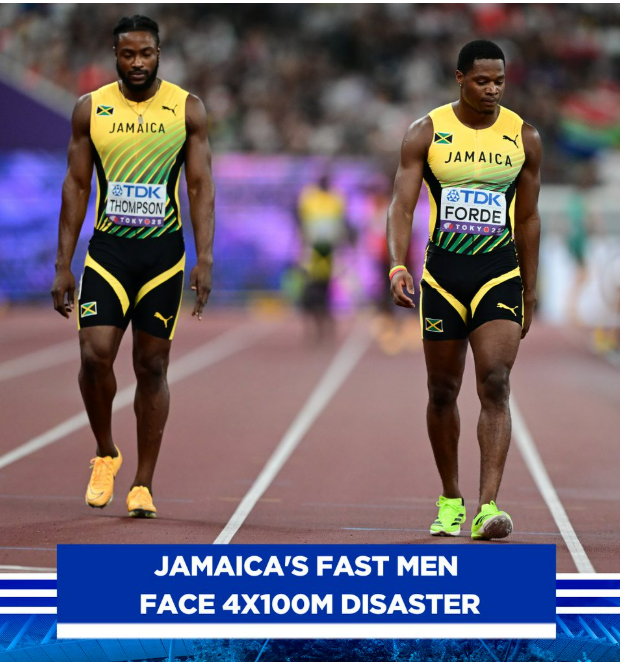
Ackeem Blake and Kishane Thompson represent the incredible depth of Jamaican sprinting that the current World Athletics rules fail to accommodate.
The Jamaica Athletics Administrative Association (JAAA) and the Jamaican government have a critical role to play in this discussion. While they have done an incredible job of fostering talent through programs like the G.C. Foster College, they must also recognize the changing landscape of the sport.
We cannot simply sit back and watch as our best athletes, from throwers like Rojé Stona to jumpers like Wayne Pinnock, switch their allegiance to other countries. We must be proactive in lobbying World Athletics for changes that reflect the unique concentration of talent in Jamaica and the world. We need to be at the forefront of the conversation, advocating for a qualification system that rewards absolute excellence rather than just relative placement within a single nation.
Furthermore, we must also look at how we can better support our athletes at home. While we may not be able to match the $500,000 signing bonuses reportedly offered by countries like Turkey, we can work to create a more sustainable professional environment. This includes better sponsorship opportunities and a more robust support system for those who are on the cusp of the top three.
Some might argue that allowing more athletes from a single nation to compete would diminish the global diversity of the sport. But I would argue the opposite. By allowing the fastest athletes in the world to compete, regardless of their nationality, World Athletics would be creating a more competitive and exciting world stage.
Imagine a World Championship 100m final with five or six Jamaicans; Kishane Thompson, Oblique Seville, Ackeem Blake, and others; all running sub-10.00. This would be a spectacle of speed that would capture the imagination of the world. It would push the boundaries of human performance and inspire a new generation of athletes across the globe.
The current system, which limits the number of athletes from a single nation, is a form of artificial leveling. It is like telling a professional basketball team that they can only have three players on the court at a time because they are “too good.” It doesn’t make the game better; it just makes it less competitive. By embracing a speed-based qualification system, World Athletics would be embracing the true spirit of the sport: the pursuit of excellence.
The Legacy of the “Sprint Factory”
Jamaica’s legacy as a “sprint factory” is something that we should be incredibly proud of. It is a testament to our culture, our coaching, and our incredible natural talent. But this legacy is also a responsibility. We have a responsibility to the athletes who have dedicated their lives to the sport, to ensure that they have a pathway to success.
We cannot allow our excellence to be our undoing. We cannot allow a rigid and outdated qualification system to stifle the careers of our best and brightest. We must be bold in our advocacy and unwavering in our support for our athletes. Whether it’s a veteran like Yohan Blake or a newcomer fresh out of Champs, every athlete who hits the world-class standard deserves a chance to compete.
I believe that the time has come for a fundamental re-evaluation of how we qualify athletes for the world stage. We must move away from a system that prioritizes placement and toward one that rewards absolute speed. This is the only way to ensure that the best athletes in the world are given the platform they deserve and that Jamaica continues to be the undisputed home of the world’s fastest people.
The future of Jamaican track and field is at a crossroads. We have the talent, we have the passion, and we have the legacy. But we also have a crisis of opportunity. The bottleneck created by the current World Athletics qualification system is a threat to our sport and to the livelihoods of our athletes.
I believe that Jamaica must take a stand. We must lobby for a qualification system that recognizes the unique concentration of talent on our island. We must advocate for an increase in the number of athletes who can qualify based on speed, rather than just placement.
Whether we like it or not, the world is watching. Other nations are already moving to capitalize on our surplus of talent. If we do not act now, we will continue to lose our “legends in the making” to other countries. This is not a lack of patriotism; it is a failure of our system to provide a pathway for our best athletes. Let us be the voice for our athletes. Let us be the champions of excellence. Let us lobby for a world where speed is the ultimate measure of success and where every athlete has the opportunity to shine on the global stage.


Leave a Reply