

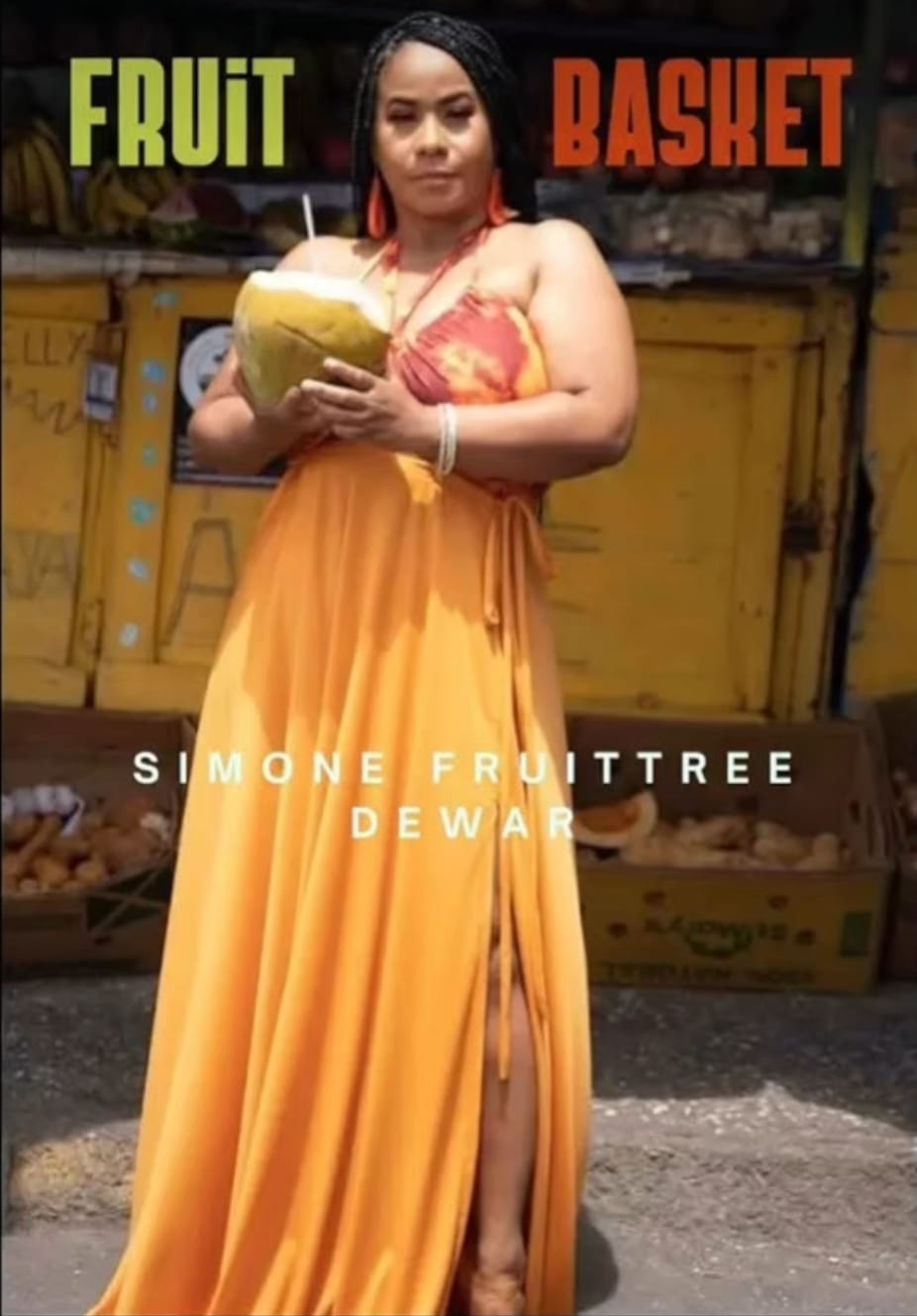
Review by Dwayne Hinds
In the quiet corners of Kingston, Jamaica, where the sun kisses earth and fruit ripens with purpose, a woman named Simone Fruittree Dewar has birthed a literary harvest unlike any other—Fruit Basket: Assorted Poetic Fruits. A vibrant, sensuous, and soul-bearing collection of 42 poems, this book is not merely something to read, it is something to sip, like chilled coconut water on a starlit night, something to peel slowly, like a mango bleeding gold onto your fingers or a chilled glass of wine. This is more than a book. It is a tree.
A Fruittree.

This book tells stories of who the author is; Simone Fruittree Dewar—mother, daughter, empress, and poet is a voice born of stillness, pain, joy, and revelation. This anthology tell you that she did not find poetry in a classroom or craft it for critique. She found it in silence. In heartbreak. In breath. In her own self.
Fruit basket tells you that Simone Fruittree Dewar turned inward and discovered divine fruit hanging heavy on the branches of her own soul. Now the author calls herself “The Fruittree” because her words are offerings not ornaments. Some of her previous work, Fruits & Truth, hinted at this blossoming. But for me with Fruit Basket, bares her entire orchard.
From the cover of this book you are in for a treat. This book’s 92-page collection is no ordinary compilation. Dewar serves her poems as ripe delicacies; each one tied to a fruit, each fruit tied to a feeling, a memory, or a spiritual dimension.
Divided into five baskets of poetic flavor, the book moves with intention:
- Tamarind – poems of introspection: sour, sincere, and grounding
- Starfruit – spiritual meditations with divine sweetness
- Cherries – lush odes to romance, longing, and intimacy
- Blackberries – sharp and aware, biting into societal truths
- Watermelon – self-love, boundaries, and healing’s cool refreshment
From beginning to end, it reads like a journey through a sacred grove. Where the fruits are feelings and each poem is a hand-pressed juice of experience.
Fruit basket is the voice of a woman who has loved too deeply, cried too honestly, and risen too many times to count. The poetry is not constructed; it grows. The language is tactile. It doesn’t sit on the page like ink; it drips, it oozes. It runs. It wraps around you.
“Commune with me,” she writes, “through both eyes and heart.”
And you do.
You can’t help it.
Each line invites you to taste. To feel. To look again.

Her metaphors are ripe in this book, sometimes bruised, always real. This books speaks of trauma as pits. Of truth as sunlight. Of love as skin that peels back to reveal pulp.
A poem in the Tamarind section lays bare childhood grief—sharp and aching, like biting a seed you didn’t know was there.
- In Starfruit, she speaks to God as a sister, barefoot in the garden, whispering secrets between leaves.
- Cherries brings heat—of skin, lips, longing. It’s where you’ll find love and lust sharing the same bowl.
- Blackberries will make you flinch; it stings with the truth of Black bodies, stolen names, and forgotten freedoms.
- Watermelon is where she comes home—to herself, her worth, her softness. The poems here are balm and border, nourishment and “no more.”
What sets Fruit Basket apart is its organic intimacy. Simone Dewar is not hiding behind metaphor—she is inside of it. The poems are not about fruits; the fruits are the poems. And we, the readers, become harvesters of meaning.
There is no barrier between poet and page. This book makes you feel like you are sitting beside her, barefoot in the dirt, passing sliced papaya and stories.
This is poetry that doesn’t perform—it confesses.
Does every poem shine equally? No. Some feel more sun-ripened than others. A few may fall flat for readers seeking intellectual acrobatics or abstract layers. But Dewar is not here to puzzle you. She is here to nourish you.
And nourishment, dear reader, is revolutionary.
This book’s power lies in truth without filter, in the writer’s fierce softness, in her refusal to conform to literary elitism. This is poetry for the people. For the mother. For the friend. For the one who’s healing. For the woman in you—no matter who you are.
Simone Fruittree Dewar’s Fruit Basket is a celebration of being, blooming, breaking, and becoming. It’s a book you don’t read once—you revisit it like seasons. A reminder that we all carry seeds. And those seeds deserve sun.
This book doesn’t ask to be understood. It asks to be felt.
It doesn’t beg to be praised. It simply offers.
And like any true fruit basket, it says:
“Take what you need, love. Take what you need.”
4.98 out of 5 Fruits – For truth, tenderness, and the healing language of growth. Because for me; I know there is more truth to be told.
Let Fruit Basket be the sweetness your soul has been waiting for.
As my nowfavor writer loves to say “ Fruittree forever blessed, I can give you fruit but yuh haffi duh di rest. Simone Fruittree Dewar’s Fruit Basket offers a tactile poetic experience—each poem is a fruit you bite into, carrying the flavor of her truth. Whether you’re in need of spiritual reflection, emotional warmth, or a reminder to love yourself, this collection serves as a balm for the heart.
Available in hardcover and digital formats online on amazon
Amazon.com: FRUIT BASKET: ASSORTED POETIC FRUITS: 9798284059241: DEWAR, SIMONE: Books

Happy reading—and may your own Fruittree bear rich, nourishing fruit!


 Urban Vine Media
Leave a reply to Royal Cancel reply