

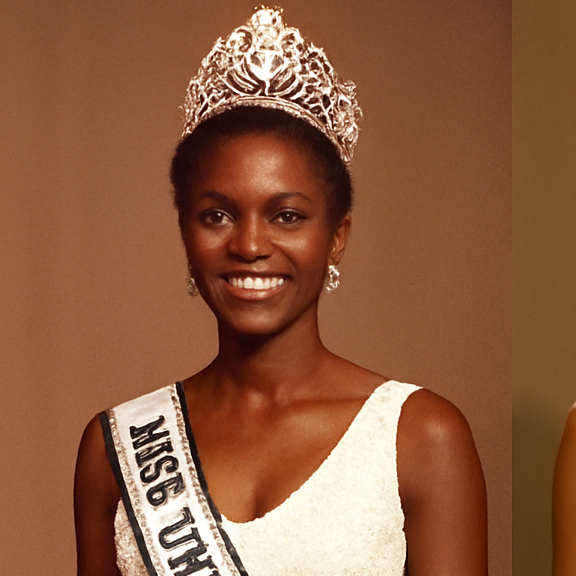
When the Miss Universe pageant first began in 1952, it presented itself as a celebration of global womanhood, a glamorous stage where beauty, intelligence, and international representation merged into one sparkling crown. It quickly grew into one of the most influential cultural platforms in the world, with millions of viewers tuning in each year to watch nations showcase their finest queens.
Yet beneath the glittering gowns and polished rhetoric of diversity lies a truth that the organization rarely addresses openly. Over the course of seventy-three years, from 1952 to 2025, Miss Universe has crowned dozens of women from across the globe European queens, Latina queens, Asian queens, Middle Eastern queens, and Pacific queens. But in all that time, only five Black women have ever won the Miss Universe crown.
In seventy-four years.
In a world where millions of Black women form a central part of global beauty culture.
This staggering imbalance forces us to confront the long-standing racial and colorist undercurrents embedded not only in pageantry, but in societies worldwide. This is a deep historical analysis of how each Black Miss Universe winner challenged and reshaped global beauty standards. Their victories were not just wins; they were cultural landmarks, political acts, and moments that broke through generational barriers.
To understand the importance of these five queens, we must first understand the history of exclusion that made their wins so rare and so monumental.
For decades after its creation, the Miss Universe pageant was steeped in Western beauty ideals. This was not accidental; the founders, judges, and global sponsors were predominantly American and European, and their perceptions of beauty were shaped by Hollywood and Eurocentric standards.
From the 1950s into the early 1970s, the typical Miss Universe winner fit the same mold:
- Light skin
- Straight or lightly curled hair
- Narrower features
- A body type deemed “universal” but based on Western norms
- A background from a nation already celebrated in global media
During this time, Black contestants were often overlooked, under-promoted, or subtly sidelined through biased judging criteria. Dark-skinned contestants from Africa, the Caribbean, and the Americas entered the competition, but rarely advanced far enough to challenge the system.
The message whether intentional or subconscious was clear:
beauty, on the Miss Universe stage, was not envisioned to include dark-skinned women.
This remained the unchallenged norm for more than 25 years.
In 1977, the world witnessed a seismic cultural shift when Janelle Commissiong of Trinidad & Tobago became the first Black Miss Universe in history.
Her win was more than a personal triumph, it was a global awakening.
Commissioning was a revelation:
- Deep brown skin
- Natural Caribbean beauty
- Grace and authority that commanded international attention
- A presence that defied every narrow definition of beauty
But what made her victory even more significant were the social and political conditions surrounding it.
The 1970s were marked by:
- Civil rights movements
- Growing demands for representation
- The rise of Black pride and natural beauty movements
- Increased cultural exchange between the Caribbean and the world
Yet despite the social progress of the era, the Miss Universe stage had never seen and possibly never expected a Black woman to wear its crown.
Commissiong’s win sparked strong reactions:
- Some celebrated her as a symbol of global unity.
- Some questioned how a dark-skinned woman could be crowned “universal beauty.”
- Some media outlets framed her win as controversial, “unexpected,” or “politically influenced.”
But Janelle Commissiong remained poised, graceful, and committed to proving that beauty was not limited to one racial or cultural expression.
She opened the door but it would take 21 more years for another Black woman to walk through it.
WENDY FITZWILLIAM (1998)
“The Return of Black Excellence And the Rebirth of a Standard”
It took more than two decades before Miss Universe saw another Black winner, a gap that speaks volumes about the challenges faced by Black contestants.
But in 1998, the Caribbean did it again.
Wendy Fitzwilliam, also representing Trinidad & Tobago, won the Miss Universe crown and became an instant icon in the world of pageantry.
Tall, regal, strikingly dark-skinned, and fiercely intelligent, Fitzwilliam redefined elegance on the Miss Universe stage. She carried herself with a calm authority that commanded respect. Her victory wasn’t just accepted, it was celebrated.
The late 1990s were a time of cultural transition:
- Media representation was slowly expanding.
- Dark-skinned models like Alek Wek were beginning to dominate runways.
- Black actresses were gaining roles that didn’t rely on stereotypes.
- Fashion magazines were cautiously starting to diversify.
In this context, Wendy Fitzwilliam’s win felt like a reclaiming. She wasn’t just a representative of Black beauty, she embodied a pan-Caribbean pride, a reminder that the region often produced some of the world’s most remarkable women.
Her victory helped pave the way for the next queen and for the first time in history, pageant lovers saw back-to-back Black Miss Universe winners.
MPULE KWELAGOBE (1999)
“Africa Ascends”
Only one year after Wendy Fitzwilliam’s win, Mpule Kwelagobe of Botswana made history as the first African-born Black woman to win Miss Universe.
Her victory was groundbreaking on multiple levels:
- It was Botswana’s first time competing.
- She became a global symbol of African beauty, confidence, and intelligence.
- She brought Africa to the forefront of international pageantry.
- She challenged stereotypes about African nations.
Mpule’s win was more than symbolic; it was transformative.
Her reign focused heavily on humanitarian work, including early advocacy for HIV/AIDS awareness at a time when the topic remained deeply stigmatized globally. Her leadership reshaped the expectation of what a Miss Universe queen should represent beyond physical beauty.
For many across the African continent, Mpule’s win was a moment of national pride. She proved that African beauty was not just valid, it was powerful, worthy, and capable of taking the highest crown on the global stage.
Her win ended the 20th century on a high note for Black women, inspiring a new generation of African and Caribbean contestants.
But it would take another twelve years before another Black queen would win.
LEILA LOPES (2011)
“The Ebony Queen Who Reclaimed the Crown”
When Leila Lopes of Angola won Miss Universe in 2011, the world was reminded once again of the beauty and brilliance of Black women.
Leila stood out for her:
- Deep ebony skin
- Elegant features
- Unshakeable calmness
- Representation of African heritage
Her win was deeply meaningful for Angola, a country rebuilding itself after decades of conflict. Leila became not just a beauty queen but a symbol of hope and national pride.
However, Leila’s victory was unfortunately shadowed by racism and colorist attacks from certain critics who claimed she did not fit their ideal of Miss Universe beauty. The underlying message was clear: many still held narrow expectations of what a global beauty queen “should” look like.
But Leila remained unbothered choosing dignity, intelligence, and grace as her response to every attack. Her win strengthened the presence of African countries in major pageants and reaffirmed that dark-skinned beauty is not only worthy of visibility but worthy of honor.
ZOZIBINI TUNZI (2019)
“The Queen Who Changed Beauty Forever”
In 2019, the world witnessed something extraordinary: Zozibini Tunzi of South Africa became Miss Universe and changed the face of global pageantry forever.
Zozibini shattered nearly every conventional beauty standard that Miss Universe had embraced for decades:
- She wore her short natural hair, proudly and unapologetically.
- She embraced her dark skin as a symbol of identity and resilience.
- She represented South African culture with authenticity and power.
- She spoke directly about racial identity, leadership, and the importance of representation.
Her final speech became one of the most iconic in Miss Universe history, reminding the world that beauty includes and must include all identities.
Zozibini didn’t just win the crown; she redefined the stage, transforming Miss Universe from a beauty contest into a platform for social change and cultural representation.
Her win inspired countless young girls to embrace their natural beauty and reject the Eurocentric standards that dominated global media for decades.
THE GAP SINCE 2019 WHY NO BLACK WINNERS AFTER ZOZI?
From 2020 to 2025, no Black woman has won Miss Universe, despite many Black contestants achieving semifinalist or finalist status.
This ongoing gap is part of a broader pattern:
- Many dark-skinned contestants still face underpromotion.
- Fan biases still heavily lean toward lighter-skinned candidates.
- Some pageant countries invest less financially in Black contestants.
- Colorism remains pervasive worldwide.
- Judges’ perceptions often unconsciously reflect media stereotypes.
Zozi’s win was a huge breakthrough, but it did not automatically dismantle systemic biases within pageantry instead, it highlighted how much more work remains.
THE STATISTICS: FIVE OUT OF SEVENTY-FIVE
When you look at the numbers, the pattern becomes impossible to ignore.
From 1952–2025:
- 73 Miss Universe winners
- Only 5 Black winners
- Black queens represent less than 7% of all crowned winners
Breaking it down further:
- Afro-Caribbean winners: 2
- African-born winners: 2
- Afro-diaspora winners: 1
- Dark-skinned winners from other continents: 0
These numbers show that the Miss Universe organization despite its branding of inclusivity has historically operated within a narrow definition of beauty.
WHY SO FEW? THE SYSTEMIC FACTORS
1. Colorism in Global Media
Lighter skin is still favored in many parts of the world, even in Black and brown nations.
2. Eurocentric beauty standards
For decades, the “ideal” Miss Universe look was modeled after European aesthetics.
3. Unconscious biases among judges
Even diverse judging panels sometimes internalize societal biases.
4. Unequal national pageant preparation
Some countries invest heavily in their contestants; others do not.
5. Marketability concerns
Sponsors often assume lighter-skinned winners appeal to more markets.
6. Political influence
Geopolitics has always affected pageant outcomes.
7. Media exposure
Black contestants often receive less coverage, making them less favored in public voting systems.
Each Black Miss Universe winner did more than win a title. They shifted culture:
- Janelle Commissiong broke the barrier.
- Wendy Fitzwilliam redefined elegance.
- Mpule Kwelagobe expanded Africa’s visibility.
- Leila Lopes reclaimed dark-skinned beauty.
- Zozibini Tunzi revolutionized authenticity and representation.
Together, they built a legacy that continues to inspire millions.
As we reflect from 1952 to 2025, the story of Black women in Miss Universe is not one of defeat, it is a story of resilience, triumph, and historical evolution.
Five crowns in seventy-three years is not enough.
But five crowns that changed the world is something extraordinary.
Their victories remind us that:
- Progress is slow, but powerful
- Representation is essential
- Colorism must be challenged
- Beauty has no singular definition
The hope for the future is that young Black women, dark-skinned, natural-haired, African, Caribbean, diaspora-born will not just dream of a crown, but will see themselves reflected in the winners who came before them.
Because when a Black woman wins Miss Universe, she doesn’t just represent her country
She represents a global community still fighting to be seen, heard, and celebrated.
 Urban Vine Media
Leave a comment