

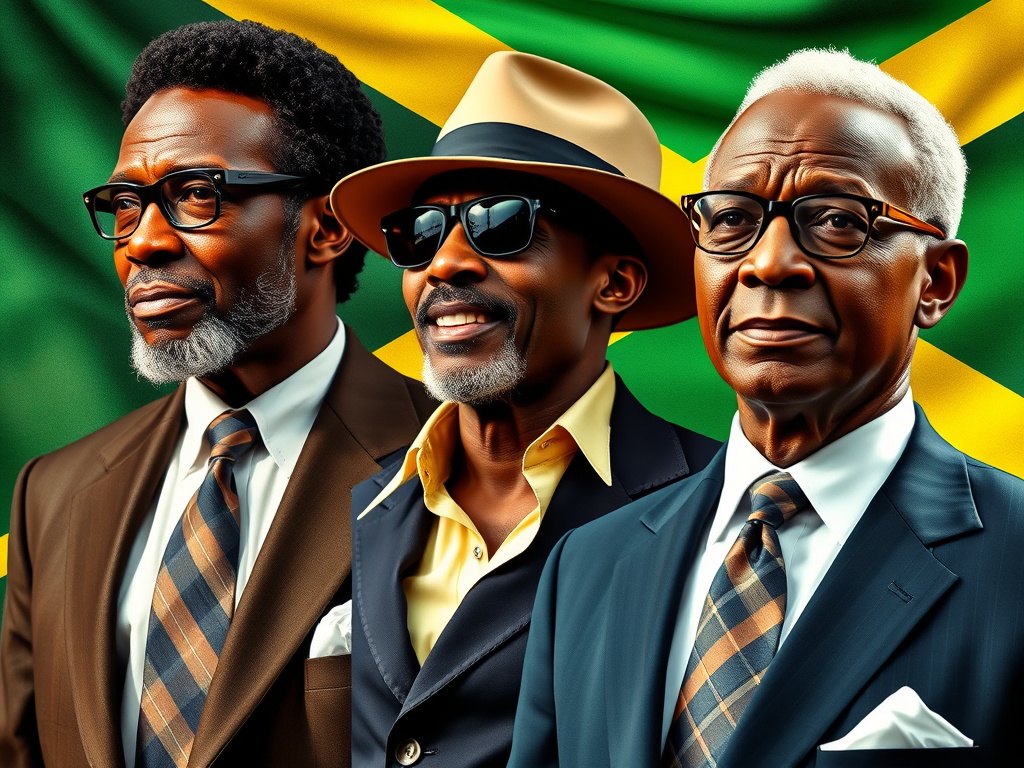
In Jamaican political history, fashion has long been more than fabric—it has been a tool of resistance, a language of solidarity, and an emblem of identity. From the revolutionary elegance of Norman Manley, the charismatic symbolism of Michael Manley, and the commanding presence of Alexander Bustamante, our earliest leaders knew that what they wore was inseparable from what they represented. Today, however, as we observe the polished suits of Mark Golding and the designer accessories of Andrew Holness, one cannot help but notice a jarring contrast—a growing distance between the fashion of leadership and the lived reality of the people.
Fashion with Purpose
Norman Manley, Jamaica’s national hero and founder of the People’s National Party (PNP), dressed with academic refinement and understated class. A Rhodes Scholar and lawyer, Norman’s style was deeply intellectual—classic suits, modest ties, and a reserved color palette. His fashion communicated seriousness, discipline, and dignity. There was no excess, no pageantry—only the quiet confidence of a man rooted in service and sacrifice. His clothes echoed his politics: cerebral, principled, and driven by a deep concern for social justice.
In contrast, Michael Manley, his son, embodied a cultural shift. While still steeped in principle, Michael was the Caribbean’s charismatic rebel. His love for the bush jacket, open-collared shirts, and locally-made fabrics was not just a style choice—it was a political statement. His fashion screamed anti-colonial pride, Pan-African solidarity, and working-class respect. When Michael donned cotton stitched by Jamaican tailors, he was not just dressing—he was declaring that power could be humble, that leadership could look like the people it served.
Then there was Alexander Bustamante, the founder of the Jamaica Labour Party (JLP) and the country’s first Prime Minister. His fashion was powerful, colonial-inspired but adapted. With his well-tailored suits, perfectly groomed silver hair, and gentleman’s cane, Bustamante looked every bit the statesman. Yet his fashion choices still connected to the people. His polish was aspirational but never performative. He dressed like a leader of a nation becoming—rooted in tradition but focused on liberation. His style inspired trust and pride in a generation of Jamaicans craving independence.
The Politicians of Today, Form Over Substance?
Fast forward to the 21st century, and the fashion of Jamaican politics has changed—and not necessarily for the better. Mark Golding, current PNP president, is often seen in crisp, expensive suits, foreign-cut blazers, and pocket squares. His style reflects wealth and global polish, but it feels disconnected. It communicates competence, yes—but not necessarily compassion. There is little in his wardrobe that speaks to the average Jamaican youth, the market woman, the farmer in Clarendon. His fashion, much like his messaging at times, feels like it belongs in a boardroom, not on the gritty, sun-scorched streets of St. Thomas.
And then, there’s Andrew Holness, Prime Minister and leader of the JLP. Holness’s style is sleek, modern, and undeniably expensive. His preference for branded labels, luxury accessories, and particularly his infamous Clarks shoes, has ignited national conversation. Clarks, long beloved by Jamaican culture, once symbolized working-class style and dancehall pride. But when Holness is seen in custom, high-end Clarks while Jamaicans suffer from inflation, underfunded schools, and rising crime, the message shifts. It no longer says “I’m one of you”; it now says “I’m above you.”
His shoes have become a lightning rod—a fashion faux pas that spits on the struggles of the everyday Jamaican. For the youth without jobs, for the nurse working overtime without PPE, for the single mother choosing between schoolbooks and groceries, Holness’s wardrobe feels less like leadership and more like luxury cosplay. In a time of crisis, his fashion lacks empathy.
Clothing the Nation vs. Cladding the Ego
The contrast between past and present could not be starker. Bustamante’s cane was a symbol of strength; Holness’s Clarks are now a symbol of separation. Michael Manley’s bush jacket said “Power to the people”; Holness’s designer threads seem to whisper “Power over the people.” Where the founding fathers wore their clothes like armor to fight for their nation, today’s leaders often wear theirs like armor to defend their egos.
Fashion, once a medium of political expression and people’s alignment, has become a shield for detachment. What was once a connection has become a costume. Today’s polished surfaces cannot hide the absence of deeper substance.
A Call for Authentic Style—and Authentic Leadership
This is not a call to return to the 1960s or to reject fashion altogether. On the contrary—style still matters. It still has power. But the question is who it’s serving. Is fashion in politics still a tool of identity, pride, and solidarity—or has it become a prop of privilege?
Jamaica doesn’t need politicians who dress rich while the nation stays poor. It needs leaders who, like Manley and Bustamante, wear their hearts on their sleeves—and their people in their pockets. We need clothing that reflects courage, not cost; humility, not hype.
Because at the end of the day, leadership is not about wearing the best shoes—it’s about walking the hardest roads with the people who put you there.
 Urban Vine Media
Leave a comment